Monday, 9 December 2013

Cantus Arcticus - Part One


Cantus Arcticus is written by Mark Jones of Wordsmith Jones Editorial Services, it is told in 5 parts, one each night this week... Mark's story Moonlight Over Inverkip is part of our A Nip in The Air Ghost Story Collection. No less terrifying is Mark's brave rifling through his teenage diaries which you can enjoy at 20 years Ago Today : A Diary of Teenage Embarassment.

The wind along Auchmead Road cut deep through Duncan’s fleece. It was a sunny day in early December but cold, fast approaching freezing. Duncan hated the Greenock wind, not because it was any sharper than that of Stirling (which it wasn’t), but because it came off the Clyde, from the sea. He hated the sea and any reminder of its vast, mysterious expanse. Stirling, at least, was landlocked, which is why – until only recently – he’d enjoyed the fifteen years he’d lived there.

Duncan loathed being back in Greenock. The streets at this time of morning were quiet – overbearingly so. In the newsagent’s all he’d heard was a short, well-intended word of commiseration from the short, well-intending elderly lady behind the till. She’d worked there for years. He knew her face but not her name. Dad would have known her well, he probably spoke to her almost every day for the last half century. Outside, back in the wind, Duncan found the rows of identical grubby houses close in around him. It was worse even than being stuck in the house, itself filled with a silence so profound it felt almost deafening.

Approaching the steps that led to the front door, Duncan found himself missing his own tidy little home just a short walk from the neat little campus where he taught. Larkfield depressed him, just as it had throughout his childhood.

Jabbing the key into the Yale lock, he pushed through a pile of mail on the soft carpet of the hallway and into the warmth of the house. It still surprised him to think he now owned it. He recoiled at the smell – an odious mix that still lingered days after Dad had passed away. The old familiar aroma of burnt sausages and stale tobacco mixed now with the strange, perhaps half-imagined, smell of sweat and decay that had built up during Dad’s last days. The smell of death. Duncan would be glad to be shot of the place, glad to get away again, and this time forever.

How odd. Duncan picked a picture frame from the carpet. It had fallen from its nail as he entered, caught, presumably, by the draft. But the frame was so small and of such cheap, light plastic that he couldn’t figure how it managed to land with such a noisy thud against the carpet. It fell with enough force to dislodge the picture inside – a grey, fading photo of Dad in his uniform, on deck, taken before the war, the blurred ghostly towers of some unknown, exotic port rising mistily behind him. Duncan supposed he ought to set the photo straight, but he couldn’t be bothered. All this junk would be binned by the end of the week. He placed the frame beside the telephone.

Sitting with a pile of paperwork on the old walnut coffee table, Duncan began to sift for anything useful. The sale of the house in Larkfield was now his last hope. While he’d enjoyed his life and lecturing in Stirling, he had private reasons for wishing to move on, reasons that now filled him enormous unease.

For two years now, he’d pinned these hopes of escape on his latest work – the most recent of his many unpublished works, this one a collection of short horror stories he’d called Cantus Arcticus. He’d been pleased with it, but only the day before he was summoned back to Greenock to witness Dad’s final illness, he’d received yet another rejection slip. The literary agent to whom he’d written evidently thought it too pretentious and its style too outdated, baulking at some of his phrasing. She seemed to take a particular and, to his mind, peculiar dislike of “squamous hideousness”, a description of which he’d been rather pleased.

This rejection piqued his intellectual pride, but, more than that, the book had been his favoured escape route. To finally become a published author, in whatever genre, would enhance his academic reputation even if it didn’t make him rich in itself. Success might lead somewhere – he might sell the rights to the stories to the movies, or get work reviewing books. Or, at the very least, it might enable him to find that elusive job he so needed in another town, at another university. Anything was possible. He just needed to focus more and make it happen. His problem, he knew, was that he’d always been a dreamer. But, surely, that was what made him a writer in the first place?

Yet Cantus Arcticus remained a pipe dream so long as agents and publishers remained squeamish of words like squamous. Now he had only Dad’s house to finance his release from worry.

The jingle of an ice-cream van broke his thoughts. It was surely too early in the day and too late in the year for ice-cream, but the local vendor must know his market, thought Duncan. The sound of women and kids huddling around the van made him realise again how quiet this house was.

There were ghosts in this house, he thought. Not real ones. That – even to a writer of horror stories – would be silly. But in the oddest of ways, every movement of his seemed somehow to disturb the house as though it were a living body. Every step, every creak from the sofa as he shifted in his seat, kicked up ghosts like dust from the carpet. Ghosts of memories locked within the very fabric of the building. Ghosts he’d rather avoid. Memories of childhood, of Mum cooking, of Janet playing, of Dad trying to crack jokes Duncan could never raise a smile for. He had only to open a kitchen cupboard and see all those ancient mugs and teacups to be reminded of them all. He hadn’t spent this length of time here since he was a teenager, and yet he wasn’t the stranger within it he felt he ought to be. It was all too horribly familiar.

Dad really must have had more than this. Duncan began sorting through pension documents and bank statements. After all, during latter years, the old man hadn’t seemed to spend his money on anything, locked up here in Larkfield, rarely going out, and never spending his pension on more than food and tobacco. He’d never been a big drinker, either, even after Mum and Janet died, so he must have stashed away quite a bit. It was simply a case of working out where. A light drizzle spattered softly against the window, a steady pattering hum that lulled Duncan’s tired, dozy mind and made him wonder whether or not he should snooze for an hour.

“Jesus!” Spat from his mouth, the word awoke him. There had been a loud clatter from the hallway. The picture frame had fallen again, this time tumbling off the telephone table. The old man grinned up at him. Duncan dropped the photo in the wicker bin beneath the table and returned through the living room to the kitchen. As he entered, he could’ve sworn he heard the tinkle of metal, of cutlery being lifted, which was strange because the cutlery drawer had indeed been left open, something Duncan didn’t remember doing. He heard laughter. From the window he saw old Mrs Dempster grabbing damp washing from the line, rescuing it from the rain. She was talking to a neighbour on the other side of her fence.

Duncan returned to the silence of the sofa with a cup of coffee, a silence too deep for his comfort. He’d play a record if he could, but of course the only ones left were Mum and Dad’s old Val Doonican and Jim Reeves albums. And they would do his mood no good at all.


If there was one thing in Larkfield’s favour, it was that you couldn’t see the sea from it, not from this house, anyway. The Clyde was obscured by the streets ahead and behind the house rose hills high above the town. Duncan loathed the sight of the sea. It acted as a constant reminder of his father’s obsession with it. It still depressed Duncan how deeply Dad had failed to understand his son’s inability to share a love for all things nautical. This incomprehension had led Dad to disapprove of all Duncan’s other adolescent pursuits – which amounted to little more than reading. Duncan, both as a child and an adult, had been an indoor kind of person, a dreamer, a loner, an embroiderer of fantasies – fantasies of places he would much rather be. Duncan had spent a lot of his life living and travelling in his head and (if he was brutally honest) never really winding up anywhere. Dad, the opposite, never could comprehend this, the salty old seadog with his interminable tales of the sea – tales of places he had already been. Dad was a doer.

In fairness, Dad hadn’t bored him with war stories as a child. In fact, he kept quiet about it until much later, during the heart scare of 1995. Then he wouldn’t shut up, as though the unexpected lease of extended life he’d been afforded gave him a desperate need to offload his life story on to others, before it was too late. Having recovered, Dad realised he was living on borrowed time. But, with nobody else left, who could he tell but Duncan? And that was the problem. By that point, it was far too late to try impressing Duncan with anything. He’d detested the old man ever since Mum and Janet died.

Dad, Suffolk farming country born but bound for sea, joined the merchant navy in 1938 and then found himself in the North Atlantic convoys during the next six years. It must, Duncan had to admit, have been a hellish experience. After the war, Dad met Mum during a stop at Greenock, they married, and he proceeded to try and win his own personal peace with a family and a job at Scotts shipyard. However, the old man had been so bullish in his continuing enthusiasm for the sea – always goading the boy to join the Sea Cadets and suchlike – that he’d alienated his young son, who wanted nothing to do with it. A lanky, spotty land-lubber, young Duncan loved books and came to yearn for the simple, warm, dry comforts of a quiet life in academia. Why couldn’t Dad have understood that?

An ocean of misunderstanding surged and swelled between them. Then, in his late teens, it threatened for a while to drown them both. Stuck in the same house together, trying to come to terms with what had happened, each blamed the other. Duncan ached to avoid the memory of that day. A row with Dad because he refused to go to Millport with Mum and Janet. Then, later, the news. There had been an accident. Dad had taken them out too far in a dinghy, the weather had broken, the helicopter came, but too late to save but one of them. Dad returned home, and never forgave Duncan for not being there to help him. Duncan never forgave Dad for taking them out that far in the first place.

These then were the ghosts that, like dust, sprang up from Duncan’s every footfall: having tried for years to escape this house, this past, each familiar household item – every coffee cup, or the pair of Dad’s old boots he’d earlier thrown in the bin – brought it all back to him; dragged him back within its, to his mind, miserable hold. Remembrance of things past he’d far sooner forget.

The grey afternoon closed in around the house on Auchmead Road and, although Duncan was too blind to the signs to realise it, so too did the past – his past, his father’s past, and all the consequences that must flow from them began to edge and creep a little closer towards him, encircling, affecting, and infecting both his present and future.

Part Two...
 

Sunday, 8 December 2013

Dead of Night Radio


Hear some spooky stories over another scary blog...Dead of Night Radio...

Or something more arcane at Tales to Terrify

If you don't already use Soundcloud, I would heartily recommend getting on there and searching out some of the thousands of scary stories shared by folks just like yourselves....here's one...


All profits are reinvested in local heritage projects.

From doomed love to haunted industrial wastelands
via ruined Roman roads and abandoned castles,
there's something for everyone to be feart of.

Saturday, 7 December 2013

Local Heroes Assemble!


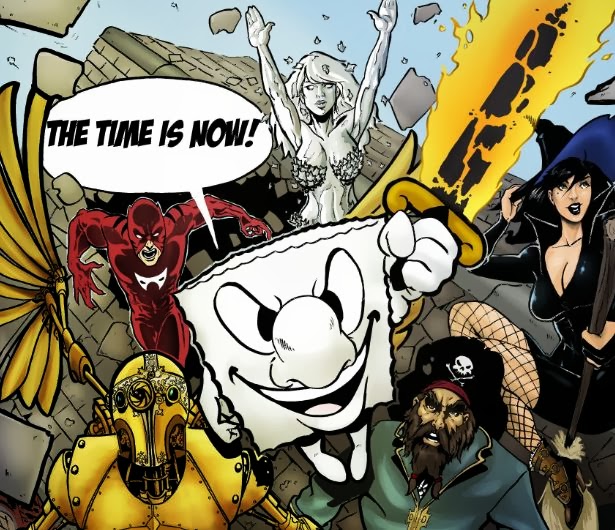
In a brief break from our regularly scheduled Christmas programming, and to try and make up a wee bit for the Big Comic Book Bash postponement last month, just had to share this preview panel for a short strip Andy and I are doing. Behold, Inverclyde's first superhero team! It was a sort of an in joke initially, inspired by the very cool Absent Voices project, but Andy did such a bang up job here that I'm thinking the guys need their own adventure. Or at the very least a teeshirt or line of 3D printed toys (assuming someone wants to buy me a 3D printer).

So from left to right we have -

Tin Jimmy - James Watt's steam powered robot, reactivated in the 21st century
Catman - Not the hero Greenock needs, but the one it deserves
Mr Cube - Tough talking hard nosed sugar cube emblem often used by Tate and Lyle
Egeria - The living statue, having adventures when not hanging around West Blackhall Street
Captain Kidd - The super pirate. Somehow.
Mary Lamont - Teenage witch, back from the dead for revenge. And perhaps dancing.

The short and sweet Mr Cube Strikes! strip will appear early next year. The first issue of our Local Heroes comic will be out...uhm...well whenever we get around to it probably. Someday maybe. Who knows? Certainly we've a couple of new comics coming out next year...

Meantime, if local heroes and mysterious steampunk robots are your thing, you may enjoy the very similar themes of my other project, kids fiction, Tin Jimmy.

Coming up next in our Ghost Story selection, it's Cantus Arcticus from Mark Jones, a terrifying tale in five parts. (Mark has put the rest of us to shame this year)

Thursday, 5 December 2013

How Much Land Does Hector Lindsey Need?


Todays's tale comes from Ross Ahlfeld...


Hector Lindsey was born in 1725 in the parish of Innerkip. Hector was a farmer who lived in a row of four cottages all joined together called Bridgend. Hector lived next door to his older brother Archibald Lindsey, who in turn lived next door to his even older brother Alistair Lindsey who in turn lived next door the oldest brother Abraham Lindsey.    

Now, Hector was not a poor man, but neither was he a rich man. Most days Hector yearned to leave farm life behind and become a rich landlord. He often thought to himself ,'if I had plenty of land, I shouldn't fear Auld Nick himself!'. Unbeknownst to him, Satan was sitting behind the stove and listening. And so the De'il quickly accepted Hector’s challenge.

So, a week later the oldest brother Abraham Lindsey took ill with the cold and died and Hector himself purchased the house and the land, and by working off the extra land he was able to repay his debts and live a more comfortable life. Then, the following week, Alistair Lindsey also took ill and died, and again Hector bought the house and the land and became even richer. Still unhappy, Hector yearned for even more land, and having become so greedy he even hoped for his last remaining brother Archie to get a fever so that he could get this land too. Sure enough, a few weeks later Archie Lindsey became sick and died suddenly and so Hector now owned all four cottages and all the surrounding land.

Hector then became very possessive of his land, and this caused arguments with his neighbors in Innerkip. And so, Hector moved to a larger area of land nearer Greenock. Here, he grew even more crops and amassed a small fortune, but Hector still had to grow his crops on land rented from the Shaw Stewart family, which irritated him. Finally, after buying and selling a lot of fertile and good land, he travelled to Gourock and across the Clyde to Dunoon then up into Argyll looking to swindle some 'daft teuchtar' or some 'uneducated Heilan Chieftain'.

Eventually, Hector heard of a once great Chieftain called Old McPhunn who was both childless and penniless. After the defeat at Culloden most Chieftains had left for France or married into the English Gentry. But not McPhunn, no Old McPhunn now sat in his draughty, crumbling castle, with his last few clansmen, all decked out in well worn, faded, raggedy plaid. Yes, McPhunn had nothing left. No sheep, crofters, no clan, nothing but…land. Lots of useless land, in fact some say he owned forests, fields and lochs stretching from the top of the great glen all the way down to the western isles.

So, Hector turned his attention to these simple-minded people who owned a huge amount of land. Hector planned to take as much of the Clansmen’s land for as low a price as he could negotiate. But the Cheiftan’s offer was very unusual; for a sum of just one pound, Hector was permitted to walk around as large an area as he wanted and take as much land as he could cover on foot. It was agreed that Hector could start at Castle McPhunn on the shore at daybreak (and marking his route with a spade along the way) he could have all the land he marked out. If he reached his starting point by sunset that day, then the entire area of land his route enclosed would be his, but if he did not reach his starting point by dusk, then he would lose his money and receive no land at all.

Hector was delighted for he believed that he could cover a great distance and had chanced upon the bargain of a lifetime. But that night, Hector experienced a terrible nightmare in which he saw himself lying dead by the feet of the Devil, who was laughing at his corpse.

Regardless, the next morning he set out early, at first light from Castle McPhunn and stayed out as late as possible, marking out the land until just before sunset. Towards the end of the day, he realized that he was far from the starting point and so he ran back as fast as he could to the waiting Chieftain and the clansmen. He finally arrived at the starting point just as the winter sun was setting. The Clansmen cheered his good fortune, but exhausted from the run, Hector dropped to the feet of Chieftain McPhunn, gasping for breath.

As he lay on the cold stone floor Hector spotted a bright red pointed tail sticking out the bottom of the Chieftain’s great Kilt. The Chieftan looked down and smiled. It is thought that Hector died on the spot of exhaustion, fright (or even shame) and so his servant buried him in an ordinary grave in the forest near castle McPhunn only six feet long, thus ironically answering the question posed in the title of this story…how much land does Hector Lindsey need? 


Wednesday, 4 December 2013

The Old Straight Track


Preview of a Roman Road tale of unease available in our Nip in the Air ebook...

What little we do know, can be gleaned from the journal entries and extensive notes which were recovered from the scene. Naturally, the whole event continues to exert a sort of macabre fascination precisely because no definitive explanations are forthcoming; however, in speaking to the representatives of Mr. Wilkins and his family, it has been agreed to make public some of the material recovered, in order to attempt to draw a line under the whole unhappy affair. While I am happy to assist in such a venture, I feel it prudent to highlight one very important caveat - the representatives asked for my assistance in reconstructing an account of Mr. Wilkins time in Greenock because of my work as a writer of speculative fiction. The family were happy for me to read the notes and fragments from his remaining papers, but did not want them published in their entirety. I can only assure the reader that all I have here set down is not a work of imagination in the traditional sense. However, taking only those words we know to be written by Mr. Wilkins himself, we can perhaps begin to imagine how some of those days upon the hilltop were spent...

Wilkins kicked the snow from his boots and surveyed the little cottage.
'Oh excellent. This is ideal Mr. Andrews.'
'There's a bed in the back room, and desk with lamps right here, just as ye asked.'
'Thank you. Thank you very much.'
Wilkins laid the larger of his two cases on the tabletop and began removing his books.
'I started a wee fire...hope it's not too sooty fur ye, been awhile since anyone's been here.'
Wilkins continued unpacking his books, 'Hmmm? No it's fine. Just fine,' he said, 'how far from here to the fort?'
Andrews stoked the fire a little.
'Best rest for now. Be dark soon. I'll be back here at eight tomorrow. There's more logs round the back.'
'Of course. Yes of course. Sorry.'
There was no hurry, Wilkins reminded himself, the fort's secrets had waited centuries up to now. Waited for him? Perhaps a little grandiose, but possible. Certainly possible. Wilkins still bristled with pride and pleasure to recall it all, how he had come to make the discoveries ,which he hoped would rewrite the current understanding of the Roman occupation in Scotland.

In theory, any of his faculty could have done it. The texts had been transcribed from the original wax tablets some years ago, and had languished in the Roman collection, packed so far away as to be unable to even gather dust. It was Wilkins who tracked them down, Wilkins who proposed their links to the previously unknown sections of the Antonine Wall, and Wilkins who - with no small sense of satisfaction - had found the maps which seemed to pinpoint their location.

Wilkins had worked very hard to convince the university to invest in the study, providing all manner of detail on the tablet translations. The truth however, was that he was yet to find anything definitive to link the Roman soldiers letters home with the area he was now visiting. He had not even completed the translations. Latin was not his strongest subject, and he had been relying on Mitchell to deal with the meticulous language work required. Yet with only one week to go until their planned journey north, Mitchell had left his campus lodgings without warning, and had not been seen since. Wilkins had called upon him, finding random pages of hastily scribbled latin scattered around his study, as if thrown about in a fury. Mitchell was not a man given to fits of passion and so this apparent rage was as curious as his abrupt departure. With arrangements made and the university waiting, Wilkins had little choice but to make the journey alone.

The Water Mill Cottage had been a stroke of luck however - unoccupied and within hiking distance of the earthworks and stones he hoped to prove were part of a Roman settlement - a small garrison outpost perhaps.

Wilkins looked rather dispiritedly at the large file of loose sheaf papers on the table. He had tried to assemble Mitchell's fragments into some sort of order, and in doing so had noticed a number of phrases and scribbled annotations repeated several times. One was a frequent cross referencing to a text which Wilkins could not find called the Liber Ivonis, the other, excerpts from a text by one GDR. Wilkins found himself entirely flummoxed by this connection, the text was a broadly derided pamphlet of the sort popular with theosophists and other such esoteric charlatans. It postulated that certain otherworldly energies run between ancient worship sites - the suggestion being that many of our communities were built upon these same sites before we discarded our pagan roots. By walking certain routes at certain times, or performing rituals at certain lunar alignments, we are apparently able to harness these energies for our own purpose, up to and including communication with the dead.

Quite why Mitchell had fixated on this particular theory was not immediately apparent. Wilkins was slightly worried that his subsequent translations, notes and annotations were coloured by this obsession.

"The letters make repeated reference to Mithras and to offerings made in supplication, honour and in return for protection. At first I assumed this was a reference to protection from the elements, even Roman Britons would not have enjoyed a winter on this hillside. However, the more I read, the more I realised they were asking for protection from some force which had been assailing the fort. I have yet to establish the nature of the invaders, though the mention of hillside fires and singing would lead me to believe we should perhaps consider some form of ritualistic behaviour perhaps linked to the energy lines which criss cross the area. It cannot be definitively understood from the maps, but I feel sure that the fort site interrupts one of these lines."


Tuesday, 3 December 2013

Tales of the Oak Christmas Special


A wee selection of Christmas related tales and artwork, including an ALL NEW strip featuring Sir Glen Douglas Rhodes and The Archivist, last seen in The Archivist's Treasure.

Don't forget that this year, for the first time, we will also be reading a selection of Ghost Stories LIVE in The Dutch Gable House on Thursday 19 December from 7-8. The cost is £2, with proceeds going towards our next year projects. Spaces are limited, so if you are interested in tickets, email aulddunrod@gmail.com or pop into The Dutch Gable House.


All profits are reinvested in local heritage projects.

From doomed love to haunted industrial wastelands
via ruined Roman roads and abandoned castles,
there's something for everyone to be feart of.