Friday, 17 February 2012

Get Folked


A wee experiment now. A potential new irregular feature of folktales and breaking folklore news from the world Outside Inverclyde.

The big ridiculous news this week (timed to coincide with the new TV series Grimm) was that apparently parents are reluctant to read their children fairytales as child abandonment, dead grandmothers and delicious gingerbread men are too frightening for todays children..or perhaps more accurately...todays parents. I've read and been read all the stories on the scary list...and yes, fairytales really only came to prominence in the Victorian era as something to share with children...but you really have to wonder about how ridiculous our "waiting to be offended" society has become when the Victorians start to look progressive. Here's the wonderful Maria Tatar talking about her book "Enchanted Hunters", which explores what inspires children to listen to and enjoy stories...even the scary ones.


Happy Saint Gobnaits Day! Who? A new study by prominent Irish folklorist Celeste finds that Irelands (many) Holy Wells are frequently associated with miraculous dragon slaying Holy Women rather than men.

Want to drink as the ancients drank? Why not try this handy recipe for delicious metheglin, a flavoured mead which predates even wine. Mmm. Fennel.

Tired of boring old Arthurian legends? Want to see them reborn in an alternative universe? Then you should help fund 13 Legends on kickstarter. Read more about this series of graphic novels here.

Where myth and archaeology collide...have British archaeologists discovered the secret of the Queen of Sheba's legendary wealth?

How has storytelling and folktale tradition changed in Iran? Explore one perspective on the history of Persian folktales.

And, on Valentines week, remember that Russian folklore tells us that a couple will only ever be truly happy if they are able to cook porridge together. (note - not a folklore euphimism, this actually means cook porridge) I hope you and your true love enjoyed yours.

Here's Lotte Reiniger's version of  Hansel and Gretel...if you can handle it...

Monday, 13 February 2012

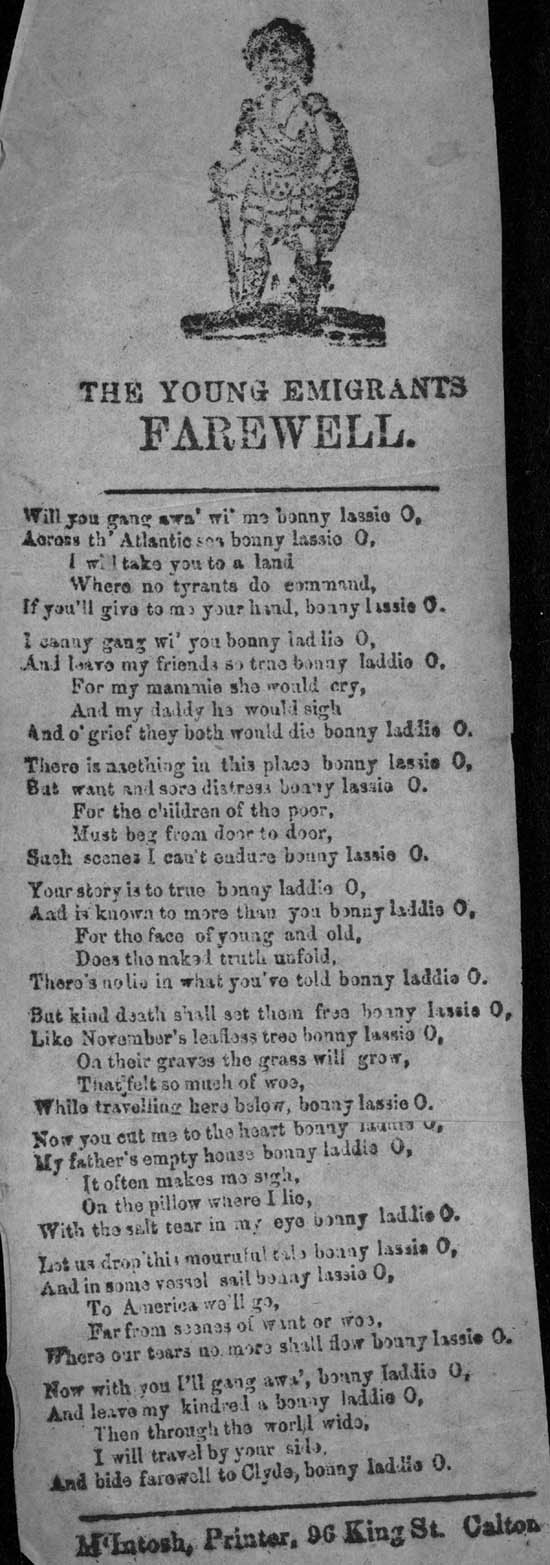
The Young Emigrant's Farewell

We've been cleaning out the old Magic Torch archive over the last few weeks (actually, archive sounds quite grand, its a battered old filing cabinet and some plastic boxes packed away in a disused boiler room) In doing so, we've discovered a few wee gems and pieces we had forgotten about ourselves which we'll be sharing with you over the month.

Last year, we made tracks from our Downriver CD available online; original copies of the CD had fourteen tracks, but we could not locate master copies for the two missing tracks...and we'd given all the original CDs away. However, we have now located the two missing tracks, and here is the first of them, "The Young Emigrant's Farewell"; rather appropriately, the only one of the tracks to be recorded "overseas" in Brisbane, Australia. You can read a transcription on the always wonderful broadside ballad site The Word On The Street.


If you are in the mood for tales of migration and are in Greenock this week, why not pop along to the Oak Mall from Friday 17 February - Tuesday 21 February to see some of the work that has been done so far by the Heritage Lottery Scotland funded Identity project. And if you are a local group with an idea for a heritage project yourself, then Grants Officers from Heritage Lottery Scotland will be in attendance to offer advice and support.

And, apropos of nothing other than just pleasantly sharing info, this Wednesday (15 February), Broomhill residents will have another opportunity to look at the historical images which will shortly be transferred to a wall on Ann Street, using a process known as "wall wrapping". From 12.30 – 2.30; the images chosen by the community will be on display at Prospecthill Church. The images are all part of the Eugene Mehat collection, used by permission of Inverclyde Council. The project has been undertaken in partnership with River Clyde Homes, Broomhill Tenants and Residents Association and The Trust.

The Mehat collection captures sixties Inverclyde, at a critical period of regeneration prior to major industrial decline...tenement closes sit alongside bombsite gaps, the stone walls caked with decades of smoke, roads are not yet clogged with cars and roundabouts, shops are still family run...a wonderful window onto our recent past.
So there ye go, now, here's the original broadside for "Young Emigrant's Farewell".

Wednesday, 8 February 2012

Old Greenock Characters


It is very likely that anyone interested in the history of the area will have come across the work of the wonderful John Donald, in particular, his two volumes of gently humourous "sketches" of the waifs, strays and ne-er-do-wells that populated the backstreets and docksides of Greenock at the turn of the 19th Century. The "Old Greenock Characters" books can be found in the Watt Library locally, and occasionally come up for sale online, you can see a video of some of the images here.

Taken alongside Williamson's "Views and Reminiscences of Old Greenock", they vividly bring to life a period in our local past, the ghosts of old characters wander down streets we now barely recognise. Donald does not seek to mock or malign the people he writes about, far from it, but reading from a modern perspective, it's hard to imagine how a book of the "characters" who have lived and died in Greenock over the last fifty years would be viewed so positively. And yet we must all have "characters" that we remember from our own period of growing up...for me, growing up in the seventies and eighties that means "Mandy" Millar, Billy the Bagman and the near mythical Catman...

We bought our copies of "Old Greenock Characters" a few years ago from a second-hand book shop down in London, and were delighted to find "bonus material" inside, a clipping from an issue of the Greenock Telegraph, containing a chapter which Donald had left out of his second collection for reasons of space. We reprinted it in a slightly different format in our book "Downriver"; enjoy the now rather curious sounding tale of "Cockin' Kirsty's Monkey" concerning the unfortunate passing of a local lady's pet monkey named (no kidding) Jacko...

Cockin' Kirsty's Monkey
“Hey, Jamie see yon. Whit’s that wife daein’ ower there?”
Jamie looked.
 “Oh crickey! That’s Cockin’ Kirsty. I think she’s diggin’ a hole; but I canna see richt for thae gracestanes.”
The boy’s, with a few companions, had been playing in the street outside o’ the Old West Kirkyard, when wee Jock, peering through the bars of the iron gate, called Jamie’s attention to the mysterious movements of the lady so rudely alluded to.

Miss Christina McKellar was the more than middle-aged daughter of a deceased shipmaster. She was financially independent and well known in the community by reason of those eccentricities of dress and demeanour which, especially the mincing gait, gave rise to her nickname of “Cockin’ Kirsty.”

The oddness of her attitude, her smirks and smiles of affected cheerfulness, the superficiality of her short primly spoken sentences, led friends and acquaintances to think that she was, as they expressed it, “happy in her own way.” Further thought of her they dismissed with a tolerant smile. No picture occupied their minds of an old maid sitting pensive in a room of her house (furnished comfortably enough) in a poor part of the town- the home of her earliest years, to which she clung for old association’s sake her thoughts drifting back to the mother of whom she could recall only as in a misty dream, to the father who had tenderly cared for and educated her and who had made provision for the material comforts of her later years. She thought of her childhood’s playmates, her schoolfellows, most of whom now enjoy the society of prosperous husbands and devoted children while she-nay, she was not unhappy, for she had her pets and she loved her pets, her canary, her  “wee broon curly dog,” and chiefest joy of all, her monkey. Life without love would rend the heart: she loved her pets and perhaps, after all, she was “happy in her own way.”

Jacko’s Death
           
But, as the old saying is, “There’s aye trouble rapping at somebody’s door.” Master Jacko sickened and died, to the inexpressible grief of his devoted mistress. With stony face she sat gazing at the lifeless form, never again to caper nimbly in his lady’s chamber. Sorrowfully she recalled his antics and found a sad consolation in the fact that even when he had torn to ribbons her best lace cap she had merely chided, she had not been too severe with him.

Gladly would she sacrifice a dozen laced caps could he but tear them now-now, alas! Dear Jacko’s gambols and tricks were over forever, forever: he must pass out her life, but not from her memory. Sighing heavily, she moved to a chest of drawers from which she took a small bag of nuts, and mourned over her dear one’s favourite food. Her bosom swelled as if the over-burdened feminine heart would break until tears, blessed tears, burst forth for her relief.
“Oh, Jacko, my poor Jacko,” she sobbed.

Now, less such grief should seem misplaced and extravagant, let us remember Charles Reade’s injunction and put ourselves in her place. A warm hearted elderly spinster who, having no human being as the object of her affection, had become attached to the only other occupants of her home, her pets might quite naturally have been grievously affected when death suddenly claimed her greatest favourite.

She mourned secretly. No kind of interment other than in consecrated ground could, it seemed to her confused mind, sufficiently honour the memory of her dead monkey: although she realised that the authorities would certainly forbid such a course of action, while her neighbours would deride it. She, therefore told no one of Jacko’s death, but privately prepared the little body for burial by wrapping it tenderly in a white linen cloth and laying it out in her room table.

The Burial

Mrs Waugh was a respectable widow woman who lived at the foot of Nicolson Street, opposite the gate of the Old West Kirkyard, of which she kept the key, visitors to the Kirk ground were apprised of that fact by a small wooden notice board at her close mouth; and as their gratuities eked out her scanty means the decent woman was very pleased to see them. She opened the door to Kirsty with a smiling face.
“It’s a fine day, Mrs Waugh.”
“Aye, it’s a’ that. Oh, its yersel’, Miss McKellar; ye’re keeping weel, I hope ma’am?”
“Quite well, thank you, Mrs Waugh; and I trust you enjoy good health?”
“I’m won’erfu’, thenk ye, ma’am. The rheumatiz brothers me whiles, but it micht be waur, an’ I hae muckle to be thankfu’ for. But will ye no’ come in ower the door-?”
“Thank you Mrs Waugh,” Kirsty interrupted, “but I called merely to borrow the key of the kirkyard.”
“Shairly, shairly, Miss McKellar; an’ gin you wait a meenit. I’ll gang doon an’ open it for ye.”
This was alarming, for Kirsty McKellar had left the dead monkey and a small spade in an obscure corner at the foot of the stair.
“No, no” she said, hurriedly, “I couldn’t think of troubling you to come down- not at all necessary, I assure you. I can open the gate quite well myself, and I may wish to spend some time in the ground.”
“Weel, well,” returned Mrs Waugh, seeing that Kirsty preferred to be unaccompanied, “here’s the key; an’ ye needna hurry, for it’s no’ likely to be wanted sune.”
Kirsty lost no time in getting down the stair and allowing the remains and spade to lie where she had placed them, crossed the street and soon had the gate open, There was no one about. She quickly went back, returned with the carefully covered body and the spade, locked the gate again, and made her way to the spot she had selected as the most fitting resting place for the remains of her pet.

Sorrowfully, yet with grim, tearless face, she applied the spade. The earth proved to be soft and yielding, she was both surprised and gratified to find that in much less time than she had anticipated a hole of the sufficient proportions for her purpose gaped before her. Kirsty then took the shrouded from and, having reverently placed it in the shallow grave, hastily filled in the earth and hurried from the kirkyard.

The Exhumation

Poor Jacko was not to remain long undisturbed. No sooner had Kirsty disappeared than the boys clambered over the gate (which she had locked after her) and sped to the scene of the recent operations. There was no mistaking the spot and the earth was speedily removed.
“Hallo! What’s this?” cried Jamie as he pulled up the shroud. “Oh crickey! (his favourite expletive). “It’s a monkey: here’s a lark.”
“Wheech?” from wee Jock, who was a bit of a wag. “A beast or a bird?”
“Shut up,” was in only reply Jamie vouchsafed as he caught the monkey by the tail and pulled it out of the hole.
“Come on, boys, we’ll hae some fun wi’ this,” and he darted off with his gruesome plaything to the gate, followed by the other boys, all shouting delightedly as they ran.
And now Jacko performed unconsciously his last acrobatic feat when, to the eager cries of “Ower wi’ him,” his body described a curve in the air and landed on the pavement outside. The boys surmounted the gate and headed by Jamie dragging the dead monkey behind him, started on a madcap run through the streets, their numbers increasing as they ran. Up Nicolson, along West Blackhall and down Westburn Square capered the merry crew. At this point the much begrimed corpse became the central figure of a series of high jinks which were interrupted by the alarm,
“Here’s the skufter cumin’” when “Skeleton” the policeman was descried at a distance.

Off they went again, past Mr Currie’s tripeshop at the corner of Sugarhouse Lane, which gave Jamie a great idea. Off along Crawford Street, down past the sugar stores in Charles Street, always dragging the now nondescript carcass over the cobbles and through the viscous deposits of that thoroughfare, to the corner of Dalrymple Street, they stopped opposite Mirren Paul’s eating-house. It had been Jamie’s original intention to carry on down the West Quay to the riverside, where a final glorious splash might worthily terminate their escapade; but the sight of Mrs Currie’s shop suggested another plan. The buxom figure of that lady in the doorway, however, was a bar to its accomplishment, so he ran on to Mirren Paul’s, where he and his followers paused.

Let us pause, too, for a moment to reflect that in her home, only a few yards away, sat Cockin’ Kirsty, satisfied that she had the day performed a meritorious act in consigning to hallowed earth the mortal remains of her cherished puggy. There, she thought, will Jacko lie in peace, at rest. With what horror would she have regarded the disorderly proceedings of that afternoon had she but known of them! She was mercifully spared the knowledge-and so we leave her, dejected yet complacent.

Mirren Paul had thriving business, and this was one of her busy days- known as “The Clerks’ Pay Day”-when many quill-drivers repaired to Mirren’s to regale themselves a bowl of tripe. In order to adequate supply their wants, the goodwife’s large cauldron was always “on the boil,” as she frequently declared.
           
Now Jamie and his keelie gang had been waiting and watching for an opportunity, and when Mirren’s back was turned, Jamie darted into the shop, dropped the dead monkey into the seething boiler and darted out again, without being observed.

Mirren came out of the back shop a few minutes later and, peeping into the boiler, was astonished to see a dark coloured amorphous mass slowly revolving among the bubbles of ebullient soup; yet her business instinct enabled her to stifle the scream which would have attracted attention to her mischance. Suspecting the cause, she hurried to the door and looked about her, but nothing unusual was to be seen. The young scamps, probably realising the wickedness of their conduct and dreading the consequences thereof, had all disappeared.

For the rest of the day, in Mirren Paul’s shop, tripe was “off.”

Author’s Note – The main facts of this story were told to me by an aged Greenockian with an excellent memory who died recently.
Certain details are, of course imaginary.    JD                                                      

We'll be looking at the Old Greenock Characters and John Donald again later in the year, in particular, digging out the legend of "Scutcher Dan's Band".


A number of the Old Greenock Characters feature on a graphic by Andy Lee, recently installed at The Dutch Gable House; it shows a few of them congregating on William Street alongside the enigmatic Sir Glen Douglas Rhodes...


Tuesday, 31 January 2012

Smugglers - Johnny Cullen

This wee story sees a hapless local criminal trying his hand at smuggling down in Inverkip...


Johnny Cullen - A Smugglers Tale by Auld Dunrod


If you want to see a wee bit of local history, Gourockguy's channel on Youtube has loads of videos of Inverclyde's nooks and crannies, including the Shielhill Cave, believed by some to have been used by smugglers

Tuesday, 24 January 2012

Smugglers


Whisky Galore

These days, Inverclyde markets itself as "Scotlands Export Capital". Central to this impressive title is our position on the river, which has long served a commercial purpose for the people of the area. For hundreds of years ships have traded with the ports of Greenock and Port Glasgow and placing the area at the heart of Scotlands economy. However, three hundred years ago, Inverclyde was more famous for its imports, though not everything that came ashore was legal. Indeed, during the 18th and 19th centuries, smuggling was a significant part of the economy of Scotland, and the Firth of the Clyde became a favourite haunt of merchants dealing in Contraband. Completely unlike today of course. Duties imposed on goods such as tobacco, whisky and tea after the Union of the Crowns in 1707 meant that illicit trade in duty free goods became a particularly profitable endevour for anyone with a boat.
           
By the barrel and crate…

The trade found a foothold in Inverkip where the bay provided the perfect location for landing goods. It seems that in this quiet little village "whisky was landed by the barrel, and tea by the crate." And just like many other parts of Scotland at that time, if it meant cheaper whisky, everyone was content to be involved, sometimes even the local minister! Normally, watertight bundles of contraband would be floated in the bay after nightfall. Then the smugglers would go ashore and check the area for customs officers. If the coast was clear, the float would be retrieved. From here, the goods could be stored safely in the numerous cellars of sympathetic villages, or quickly transported to Greenock or Glasgow by coach.

The Increase of Smuggling

John Galt in his famous work of fiction Annals of the Parish, widely believed to draw heavily on the history of Inverkip, gives an interesting account of smuggling in the mid 1700’s:

“It was in the year 1761 that the great smuggling trade corrupted all the west coast, especially the laigh lands. The tea was going like chaff, the brandy like well-water, and the wastrie of all things was terrible. There was nothing minded but the riding of cadgers by day and excise men by night – and battles between the smugglers and the king’s men, both by sea and land. There was a continual drunkenness and debauchery; and our session, that was but on the lip of this whirlpool of iniquity, had an awful time o’t.  Before this year, the drinking of tea was little know on the parish, saving amoung a few of the heritors’ house on a Sabbath evening; but now it became very rife.”

3 Pints and a dram

The incidents of smuggling in Inverkip are numerous and well documented. One well known case is that of Thomas Finnie, a local milkman, whose tale is recorded in the records of the Innerkip Society:

“Early in the morning of the 22nd of December, 1809, about 6 am, Thomas Spence, Supervisor of Excise in Greenock, could have been seen – suitably armed with pistol, etc – riding through the slush to Inverkip accompanied by two other officers. Almost exhausted and perished with the cold after their unusual errand they espied Thomas Finnie’s milk cart. They lay in wait near the Daff burn and when Thomas had reached that point on his way to the “big house” with his morning delivery, the command to halt came from Spence. Mr Spence immediately searched the cart and in addition to the usual and necessary commodity of milk, he found three casks of Highland whisky containing in all 30 gallons. The horse, cart, milk and whisky and, of course, Thomas, were seized and taken in charge when, suddenly, Spence spotted Robert Cochrane some distance off. Cochrane was also searched and his cart was found to contain 50 gallons of Whisky. Both carts, their contents and their owners were marched on to Greenock Bridewell.”

Pistols at the ready

While many of the incidents at Invekip were tame and relatively free from violence, this as not always the case.  Encounters between the excisemen and smugglers or their customers for that matter were at their worst when the cargo consisted of food, and people  were hungry.One account tells of riots at Greenock when a ship tried to land a cargo of food from Ireland.:

'...a most violent and outrageous mob has risen at Greenock and by force broken open the hatches and carried away the sails of the vessels laying in that harbour laden with oatmeal...and taken and carried away all the said meal despite of whatever could be done to prevent it...'

The complement of 20 dragoons stuggled to  control the mob of several thousand locals. The intervention of a local magistrate almost ended in tradgedy, and would surely have resulted in his death, were he not dragged off to the custom house for his own safety.

Another case also tells of violent side to the smuggling industry, when during an encounter with smugglers at Lunderston Bay, a revenue officer was brutally killed as he tried to prevent the criminals from escaping.

Customs HQ

The extent of the smuggling industry on the west-coast was in part responsible for the creation of the new Custom House at Greenock. The building was finished in 1818, and stood as a warning to all on the Clyde that the excise men were present in force.  It is thought that this is the last of a long line of custom houses sited in Greenock; previous ones included a building in Cathcart street and an office at the West Quay. The Customs service of Greenock sports some famous connections; Burns spent some of his career as an excise man in Greenock and while the location of the very first excise office remains unknown, it is recorded as having been in operation during the cattle raids of Rob Roy, when local men were sent out to deal with the Highland rogue on a number of occasions.

Inverkip – Import Capital of Scotland

The last reported case of smuggling occurred in Inverkip in 1888, when a large amount  of tobacco was seized. However, the customs maintained a presence in Inverkip for many years to come and until the 1900’s, tow coastguard officers were a familiar sight in the village, keeping watch over the bay with a keen eye and polished binoculars. Today, there is little to link the village to its days a smuggling den, only the romantically named, though somewhat unimpressive Smugglers Cave stands as a memorial,  a few miles behind the town. Some people have speculated that the mysterious skull and crossbones headstone in the villages old cemetery marks the final resting place to one of Inverkip’s shadowy smugglers; a fitting monument to this dark and romantic chapter in the history of this little village.

(text by Neil Bristow)

Monday, 16 January 2012

Saint Fillan


January 19th sees the feast day of a Celtic Missionary associated with the area, Saint Fillan...

After the victory of the Christian forces at the epic Battle of Arderryd, the growth of Christianity continued unabated in Scotland. The Celtic saints played a great part in this, Saint Columba having unified the many disjointed missions into a whole. For the next 150 years, the Christian word carried to the furthest reaches of Scotland. It was against this background that St. Fillan arrived in this country, some time around the early 700s.

Fillan, whose name literally translates as ‘wolf cub’ was born to Federach, a prince of the race of Fiatach Finn, and Kentigerna, a princess of Ulster. As the legend has it, he was born with a stone in his mouth. Federach saw this as a sign that this child was a curse to him, and threw him into a lake. However, Fillan was kept safe by angels, who watched over the child until he was discovered by Bishop Ibar. The Bishop raised him as his own child, in the Christian faith. Kentigerna kept a distant but watchful eye on her son, and was thankful to Ibar and his monks for caring for her son. Fillan’s mother, too, would later become a missionary.

When Fillan landed on our shores, his mother and cousin Comgan accompanied him, they first settled in Lochalsh, in Wester Ross; later Fillan would travel to Glen Dochart, his mother retiring to Inch Cailleach, ‘The Nun’s Isle’, on Loch Lomond, where she died in 734 A.D.

The Exploits of St. Fillan
To this day, stories are rife of Fillan’s trials and adventures during the years when he was founding his missions. One such famous tale tells of a wolf who attacked and killed one of Fillan’s oxen while he was ploughing his fields; the wolf subsequently returned and allowed himself to be yoked. The animal would go on to aid Fillan in his ploughing, and help him build his priory. This tale is seen by some as an allegory for Fillan ‘taming’ the wilder elements of ancient Celtic culture.

Another legendary tale speaks of Fillan’s battle against a fearsome boar in Killin. Fillan arrived there having parted company with St. Columba’s biographer, Adoman, at Tyndrum, only to hear the town’s tales of woe concerning this hideous beast, said to have ‘tusks the size of plough shares.’ Fillan set off into the forests to hunt down the boar, accompanied by his dog Dileas. Finding the enormous creature three days later, rooting beneath a rowan tree, Fillan held onto his simple wooden club as the boar turned on him and charged. Fillan brought the club down on the monster’s head, killing it with one blow.

Tales of saints killing great beasts are far from uncommon; it is said that St.Columba defeated a mighty boar on Skye in a similar legend. These stories, true or not, play a part in idealising the saint figure, making him almost Godlike, and ensuring that his name will carry on through history; such is the Ossianic tradition of the hero in Celtic culture.

Kilallan
The focal point of St. Fillan’s labours in Scotland appears to have been Strathfillan in Perthshire, where a long stone known as St. Fillan’s seat still remains. Nearby in a mill thought to have been built by the saint, seven holy stones, believed to have healing powers, are still preserved to this day. Strathfillan is not the only site with strong links to the saint, and during his many travails throughout the country he seems to have founded churches in both Skelmorlie and, more importantly, in Kilallan, near Kilmacolm.

The name itself seems to be a corruption of Killfillan, i.e. Cella Fillani - the Cell of Saint Fillan. Here, on the Kilmacolm road to Houston, stand the ruins of a medieval church said to have been established by the saint during a long period of labour in the area. Nearby, a large stone with a hollow in the middle is also remembered as St. Fillan’s Seat, the place where he is thought to have preached to a small number of followers. Such frequent and personal references to the saint certainly attest to the significance and impact of his work in the region.

However, the most famous shrine with a connection to the saint is St. Fillan’s Well, a stone’s throw from Fillan’s Seat in Kilallan. Here, under a rock, shaded by overhanging bushes, it is said that countrywomen would bring their weak and sickly children to be healed by the holy waters, leaving a small keepsake or offering hanging from the bushes. A similar practice was followed at Fillan’s well in Skelmorlie; the plethora of wells associated with Fillan testifies to his reputation as a healer. In Kilallan, pilgrimages to the well went on until the end of the 1600s when the local minister, one Mr. Hutcheson, had the well filled with stones. Fillan’s feast day was still celebrated with a fair on the same day for many years to follow, and in the nearby village of Houston the parish church still bears his name, as does the episcopal church in Kilmacolm. There are loads of great images of the church here at Derelict Places.

St. Fillan’s death is recorded on the 9th of January 777 (this, of course, is a date on the Julian calendar; on the Gregorian calendar, Fillan’s death is marked as the 19th of January).

Fillan’s followers preserve many relics associated with the saint; the most famous of these is the Mayne, the arm-bone of Fillan, which was kept in a silver case after his death. Such is the significance of this object that King Robert the Bruce requested it to be brought to him on the eve of the Battle of Bannockburn; however, the keeper in charge of the relic feared it would be damaged or lost, and brought the Bruce an empty case. As the king meditated over the case, praying for guidance during the coming battle, a mighty crack was heard from the silver box, and when opened it revealed the Mayne. The keeper, dumbfounded, admitted that he had not brought the bone with him. Whatever the truth of this story, the bone was undoubtedly carried into battle the next day, and the story may well have inspired the Scots to new bravery in this battle which liberated Scotland from the English rule.


http://www.derelictplaces.co.uk/

Tuesday, 3 January 2012

Some Art Is Useful


It's a typically grim New Year Monday, so here's just two things that have cheered us up over the weekend.

We were delighted to see the arrival of a facebook page to celebrate the legend of The Greenock Giant Squid. And it wasn't even us that set it up. What legend? Well..the legend printed in popular music paper NME in a live review for the band Tailgunner in Rico's Wine Bar...an event now itself the stuff of legend. We reckon the squid might be a wee bit of a retake on the Legend of the Gourock Monster....which this year, celebrates it's 70th Anniversary of being dead and buried under some Gourock school or other.

Also down in Gourock, we've been slowly won over by the arrival of the new Gourock statue "Girl on a Suitcase". It's dead easy to be cynical about public art, I've done it myself loads of times. Generally though, it works best when it connects with people, whether that's about involving community in the design, or selecting a subject that resonates with the community that surrounds it. That's why a wood nymph and a big daft dead horse might reasonably struggle in Greenock town centre, but a wee lassie on a trip "doon the watter" fits just right at the Gourock riverside. And apparently the kids involved on the day of the unveiling called her Annie...not sure if that's official, but it has a nice ring...Annie Kempock.

Nope. Not everyone likes it. Why would they? It's art. But it's nice, just for a change, to see at least some people liking something, making her part of the community by dressing her in hats and scarves for winter...

Wee Annie Kempock, watched over by her Granny up on the hill.

Gaun yerself.